Posts

Showing posts with the label onlineinteractiveactivities

Teaching Types of Animals Based on Food Habits: A Fun and Interactive Game- Running Race

Image
Teaching about herbivores, carnivores, and omnivores can be engaging and educational with the right activity. Here’s an interactive, movement-based classroom game I recently used to help my students learn about different animals based on their food habits. This activity encourages observation, quick thinking, and physical activity, keeping students engaged while reinforcing learning. Here’s a step-by-step guide to the activity: Materials Needed: Flashcards of various animals (herbivores, carnivores, and omnivores). Three images to represent food habits: plants, meat, and both plants & meat. Adhesive (sticky notes, tape, or magnets) for pasting cards on the board. Step-by-Step Instructions: 1. Preparation: Create flashcards with different animals printed on them. Make sure you have a mix of herbivores, carnivores, and omnivores. On the classroom board, paste three large pictures: one showing plants, one showing meat, and one showing both plants and meat. These images represent the d...
WH Questions Lesson Plan- Fun and Engaging Way of Teaching Method for Primary Students

Image
Lesson Title: Exploring WH Question Words  Grade Level: Primary Subject: English Starting with flashcards is an effective way to visually introduce and reinforce WH question words. This method should align well with this approach and engage your primary students effectively. Objectives: To introduce and familiarize students with WH question words (who, what, where, when, why, how) using flashcards. To enable students to understand when and how to use WH question words. To practice forming and asking WH questions. Materials Flashcards with WH question words. Pictures or illustrations related to daily activities. Whiteboard and markers or a digital board if available. Procedure: Begin by displaying the flashcards with WH question words on the board. Engage the students by asking if they recognize these words and if anyone knows what they are used for. Explain that today's lesson will be all about these special words and how to use them effectively. Activity 1: WH Questions with Flash...

Top Digital tools for Teaching and Learning Science. Virtual Lab Simulations for Engaging Learning and STEM Education

Image
In today's ever-evolving educational landscape, digital tools have emerged as a transformative force in the field of science education. As science teachers, we constantly seek innovative ways to engage our students and make complex scientific concepts more accessible and exciting. This quest for more effective teaching methods has given rise to a wide array of digital tools and resources that can revolutionize the way we deliver science lessons. In this blog post, we will explore some of the most valuable and versatile digital tools available to science educators. From interactive simulations to online labs and multimedia resources, these tools have the potential to inspire curiosity, facilitate hands-on learning, and empower students to explore the wonders of the natural world in ways we could only dream of in the past. Here are the top virtual lab simulations and tools for engaging learning and STEM education 1. PhET SIMULATIONS:  PhET simulations are a valuable resource for scie...

All about Sense Organs Lesson Plan - Interactive slides, game and worksheet.

Image
Topic: My Sense Organs Subject: Science Garde: Primary Learning Skills: Reading, speaking, and creative thinking. Objectives: Students should be able to identify the sense organs. understand the functions of sense organs talk and write about the importance of sense organs Preparatory: Prepare a set of five flashcards related to the functioning of sense organs. Use the below statements to prepare the flashcards. Examples: 1. Ice is cold. 2. The elephant is big. 3. Flowers smell good. 4. Candy is sweet. 5. Mobile is ringing. Show the below puzzle cards to the students. Tell them to observe the picture and guess the organ to notice the action. Read the statements to help them to find the organ.  At the end of the activity ask them 'what do we call these organs?'  Presentation:     Explain to them "eyes, ears, nose, tongue, and skin are called sense organs."  The human body has five main sense organs- eyes, which provide the sense of sight; nose, which provides the...

12 Free Teacher ICT Tools to create interactive content and games. Digital tools for teachers.

Image
                     Technology has the ability to enhance relationships between teachers and students. When teachers effectively integrate technology into subject areas, teachers grow into roles of adviser, content expert, and coach. Technology helps make teaching and learning more meaningful and fun. Students also develop positive feelings of exploitation by mastering new knowledge and skills using digitized learning tools. Here I am presenting some of the most popular free educational tools. 1. CurrikiStudio: CurrikiStudio  brings you the tools to create interactive learning content like never before. Free authoring software with mobile-first activities including interactive multimedia, images, games, virtual tours, and simulations.  This is the very best tool to make interactive content like different image-based, video-based learning content, and comprehensive activities. You can also create listening comprehension ac...

"Our Needs - Water" - Lesson plan and activities

Image
Lesson: Our needs- Water Grade: Primary and Upper primary Subject: Environmental Science                   All living things need water to live. Water is also used for different daily activities, which happen at home, schools, offices, shops, factories, and many places around us. This is a cool lesson plan having great activities. In this lesson plan, we are going to discuss the sources of water, the water cycle, the importance of saving water, and keeping the water resources clean and safe.   Objectives: By the end of the lesson, students should be able to:   learn what are the different sources of water. know the uses of the water. learn what is the water cycle. know about evaporation, condensation, and precipitation. ask questions during the discussion. understand the importance of saving water. come up with ways to reuse water. understand the importance of keeping the lakes and ponds clean. Material: flashcards, worksheets...

Animals around us: Oviparous, Viviparous, Herbivores, Carnivores and Omnivores - Lesson plan, Interactive Activities and Worksheets.

Image
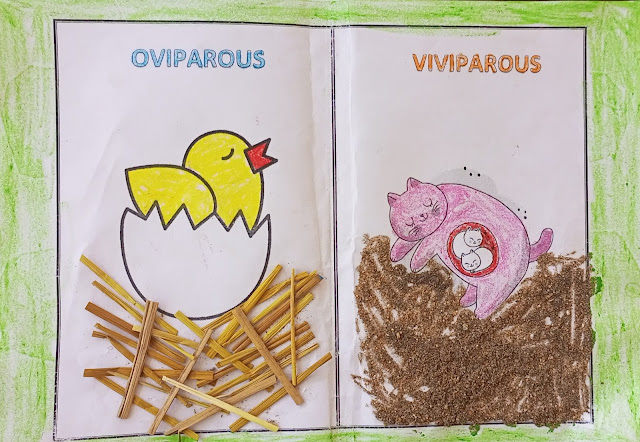
Lesson: Animals around us Topic: Oviparous, viviparous, herbivores, carnivores and omnivores. Subject: Science Grade: Primary and upper primary Material: flashcards, interactive videos, and worksheets. Learning outcomes:  Identify different features  of birds and animals. classify carnivores, herbivores, and omnivores. know about the group behaviour of animals and birds. show concern towards animals and birds.            Here is a simple lesson plan and interesting activities to teach about 'how animals birth?' and what they eat?  Task 1: Show some animals and birds flashcards and have a discussion. Ask students, where do they live? how are their body and shape? ..etc Now tell your students to classify those animals into two types and write them in the below table.  Task 2:               Now tell your students that animals are two types based on their birth. Use the below picture to explain the concept....

Interactive Quiz -"Simple past and Present perfect." and "Could you and Would you mind."

Image
  Topic: "Simple past and Present perfect." and "Could you and Would you mind." Here is an interactive quiz to practice the "Simple past and Present perfect." And also have some bits of "Could you and Would you mind." You can download the PPT from the below link.  This is an embedded Microsoft Office presentation, powered by Office . Download the PPT

The MISSILE MAN OF INDIA- APJ ABDUL KALAM Life Story- Digital Lesson and Project Work.

Image
Lesson: The Missile Man of India - APJ ABDUL KALM Subject: English Skills: Reading, writing and presentation                                  Here I have prepared this lesson using the "StoryMap Js " tool. This is an interactive tool connected with maps. Along with this, I have given a link to a quiz on TED-Ed. Students can watch the video and take the quiz. I have taught the lesson to my students and given a task to prepare an "Abdul Kalm's Missile". Here you can see the pictures of my student's work. Bio of APJ Abdul Kalam:                               Avul Pakir Jainulabdeen Abdul Kalam was born on 15 October 1931 to a Tamil Muslim family in the pilgrimage centre of Rameswaram on Pamban Island, then in the Madras Presidency and now in the State of Tamil Nadu. Abdul Kalam was an Indian aerospace scientist who served as the 11t...

TEACHING "WH" QUESTIONS - Lesson plan and activities.

Image
Topic: ' Wh'- Questions Subject: English Grade: Secondary Objectives: By the end of the lesson, students should be...                           able to construct interrogative sentences.                          able to understand the use of "Wh-question' words.                Questioning is a major form of human thought and interpersonal communication. Questioning is fundamental to successful communication - we all ask and are asked questions when engaged in conversation. So here is a lesson plan for teaching questioning using"Wh question words."                The ability to ask WH questions is important and proper understanding is needed for the students. Before introducing questions from the text, they need to have a good foundation, things like what a question is and loo...