Posts

Showing posts with the label teachingenglish

"Let Us Get to Know Each Other" – A Fun WH-Questions Teaching Idea, Craft Activity, and Worksheets.

Image
"Let Us Get to Know Each Other" – A Fun WH-Questions Craft Activity In this blog post, I’ll walk you through an exciting classroom activity I conducted to teach WH questions to my primary students. Teaching WH words like “Who,” “What,” “Where,” and “Why” can sometimes feel repetitive, but by adding a craft activity, I was able to make it engaging, creative, and fun for my students. Objective: The activity aimed to help students understand and use WH words in questions and answers while allowing them to interact with each other in a meaningful way. Materials Needed: WH-question worksheets (separate sheets for boys and girls) Crayons or colored pencils Scissors Glue sticks White paper sheets Pencils Step 1: Introduction to WH-Words I began the lesson by introducing the WH words (Who, What, Where, When, Why, How) on the board. I explained the meaning and usage of each word with examples: Who -is used for people. What -is used for things or actions. Where -is for places. When -i...
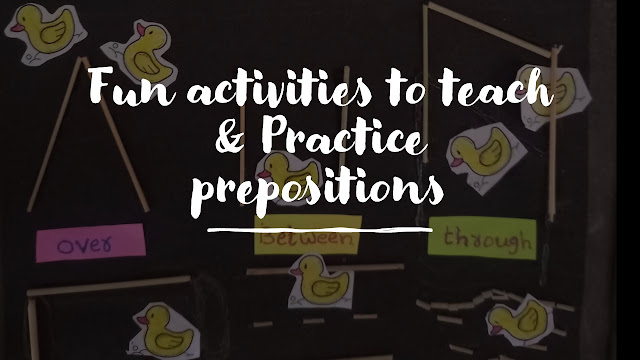
Fun activities to teach and practice "PREPOSTIONS" for children

Image
Topic: Prepositions for Place Subject: English Grade: Primary. Skills: Grammar and creative thinking. Prepositions often involve complex language structures. Teaching these structures requires careful consideration of the age-appropriate language level and the ability to simplify concepts without losing their essence. Children, especially in the early primary years, may have a limited vocabulary. Teaching prepositions often involves introducing new words that describe spatial relationships, and this can be overwhelming for students who are still building their language skills. Despite these challenges, using creative and interactive teaching methods, incorporating games, stories, and hands-on activities, can significantly enhance the effectiveness of teaching prepositions to children. Providing multiple opportunities for practice and reinforcement can help solidify their understanding over time. Here are some hands-on activities to teach and practice prepositions of place for ...

A Creative Writing Task and Craft Activity- Swami Vivekananda Lesson

Image
Fun and creative writing tasks can serve as a great source of motivation. Students are more likely to look forward to writing activities, which can result in better participation and overall learning. Creative writing activities encourage children to use their imagination, explore their ideas, and express themselves in unique ways. This helps in fostering creativity and individuality. Here is a simple, creative, and interactive writing activity for primary students to write about the qualities of a great personality. You can use this activity to write about the important events and activities that happened in the life of great personalities. See the activity.   Activity:  Required Material: Colour papers, glue, markers, picture of the great personality.  Procedure:  I instructed my students to read the lesson about ' Swami Vivekananda." Told them to identify the qualities that he had. Told them to list out the qualities.  Guided them to draw past the image of th...

My Family Creative Activity- Family Theme Activities for Kindergarten and Primary Students

Image
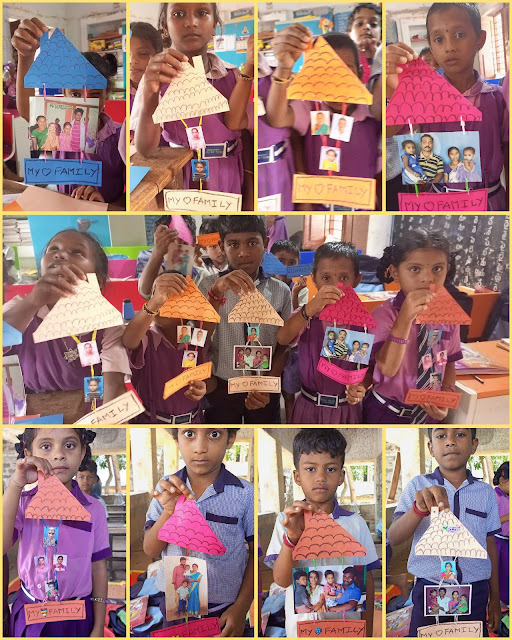
Topic: My Family Activity name: "Family Memory Collage" Material needed:  Family photos (ask students to bring their family photos or use printed images) Stopper pins (or paper clips if stopper pins are not available) Color cardboard sheets (various colors) Color pencils Scissors Glue or glue sticks Markers Decorative items (optional) This is a simple and fun activity for kindergarten, grade 1, grade 2, and primary students about the theme of my family.  Start the lesson by discussing the importance of family and memories. You can share a short personal story or ask your students to share their experiences related to their families. Watch the Video Instructions: Distribute the colored cardboard sheets to the students. Tell them to cut the sheets like the roof of the house and the rectangle base. (Shown in the picture.) Tell them to draw curves on the roof shown in the picture. Tell them to write "My Family/ My Lovely Family" on the rectangular shape and draw a borde...

WH Questions Lesson Plan- Fun and Engaging Way of Teaching Method for Primary Students

Image
Lesson Title: Exploring WH Question Words  Grade Level: Primary Subject: English Starting with flashcards is an effective way to visually introduce and reinforce WH question words. This method should align well with this approach and engage your primary students effectively. Objectives: To introduce and familiarize students with WH question words (who, what, where, when, why, how) using flashcards. To enable students to understand when and how to use WH question words. To practice forming and asking WH questions. Materials Flashcards with WH question words. Pictures or illustrations related to daily activities. Whiteboard and markers or a digital board if available. Procedure: Begin by displaying the flashcards with WH question words on the board. Engage the students by asking if they recognize these words and if anyone knows what they are used for. Explain that today's lesson will be all about these special words and how to use them effectively. Activity 1: WH Questions with Flash...

Top Digital tools for Teaching and Learning Science. Virtual Lab Simulations for Engaging Learning and STEM Education

Image
In today's ever-evolving educational landscape, digital tools have emerged as a transformative force in the field of science education. As science teachers, we constantly seek innovative ways to engage our students and make complex scientific concepts more accessible and exciting. This quest for more effective teaching methods has given rise to a wide array of digital tools and resources that can revolutionize the way we deliver science lessons. In this blog post, we will explore some of the most valuable and versatile digital tools available to science educators. From interactive simulations to online labs and multimedia resources, these tools have the potential to inspire curiosity, facilitate hands-on learning, and empower students to explore the wonders of the natural world in ways we could only dream of in the past. Here are the top virtual lab simulations and tools for engaging learning and STEM education 1. PhET SIMULATIONS:  PhET simulations are a valuable resource for scie...

The Recipe Book - Cooking Up Teamwork - Lesson Plan and Activities to Teach

Image
Lesson: Cooking Up Teamwork (The Recipe Book) Grade Level: Primary School (Suitable for English, Moral Science, or Character Education) Subject: English Language Arts                  What a wonderful story! It's a great example of teamwork and cooperation among different elements in the kitchen. This story could be used as an engaging way to teach primary school students about collaboration and problem-solving. You could turn this story into a creative lesson plan where students get to play different roles like the pot, mixer, knife, and stove, and work together to "prepare" a virtual meal just like in the story. This hands-on activity would not only make the lesson interactive but also teach the important values of helping and working together. Objectives: Understand the concept of teamwork and collaboration. Identify and discuss the roles of different kitchen tools in the story. Promote empathy and helping behavior among students. Material...

How to teach PUNCTUATIONS for the Primary Students - Lesson Plan and Activities

Image
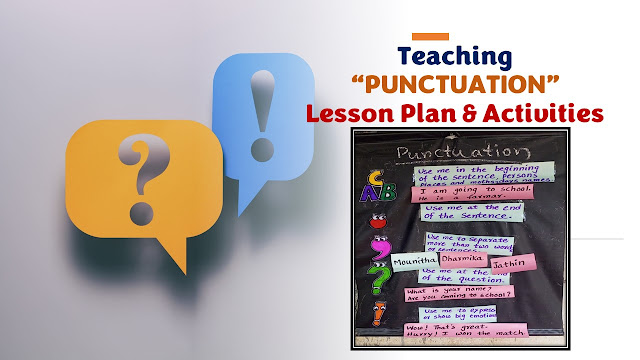
Lesson Plan: Introduction to Punctuation Marks Grade Level: Primary  Duration: 30 minutes              Here is a simple, creative, and fun-filled lesson plan to teach punctuation topics to the primary students.  Objectives: 1. Introduce primary-level students to basic punctuation marks. 2. Familiarize students with the purpose and usage of different punctuation marks. 3. Teach students to recognize and use punctuation marks correctly in their writing. Materials: 1. Whiteboard or blackboard 2. Markers or chalk 3. Punctuation mark flashcards. 4. Worksheets (optional) Procedure: 1. Warm-up Activity: Begin the lesson by asking students if they know what punctuation marks are. Engage students in a short discussion about why punctuation is important in writing. Give a few examples of sentences with and without punctuation, and ask students to identify the differences in meaning. 2. Introduction to Punctuation Marks Display or distribute flashcards ...

"Sound-Alikes Made Simple: Engaging Activities for Teaching Homophones"

Image
        Homophones are words that have the same pronunciation but different meanings and spellings. Here are some fun activities to teach homophones to primary students.    1. Homophone Dictionary Hunt: List out 20 sets of Homophones and write them down on the board. Distribute an activity sheet (Colour Paper)  Tell your students to choose any of the 5 set homophones and write them on the activity sheet in blocks. Tell them to open their dictionaries and find the meanings of the pairs. Tell them to write their meanings under the words as shown in the below activity sheet. And also tell them to write a sentence using the word given in the dictionary. Facilitate them to write properly in the given activity sheet and complete the activity. Click here to watch the video.   2.  Homophone Bingo:               Create bingo cards with homophones on them. Call out the definition of a homophone and have the stude...

6 Creative Writing Tasks for Better, Understandable and Effective Writing

Image
Topic: Techniques for writing tasks, Skill Focused: Writing, Grade: Primary and Lower Secondary.                                                       Writing is one of the biggest challenges for teachers. Because children do not want to write. Especially in second language classrooms, teachers are facing big trouble in giving writing tasks.  When we ask students to write, often we are just testing their skills rather than teaching them how to write or how to improve their writing. So teachers need to encourage their learners by assigning interesting writing activities.                             So, here are my techniques to help learners dig deeper when they write. These six c reative writing tasks help learners for better, understandable, and effective writing. ...

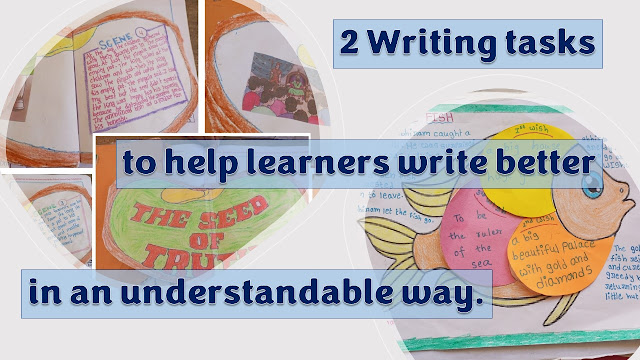
2 Writing tasks to help learners write better in an understandable way.

Image
Topic: Techniques for writing tasks, Skill Focused: Writing, Grade: Primary and Lower Secondary.                          Supporting students to tune into the creativity needed for writing through a range of experiences is key to developing imagination and ideas for writing in all forms. Actually, writing is intricately linked to critical thinking. It also has implications for performance across all areas of the language. Writing is how a child shows what he or she knows and what has been learned. When we ask students to write, often we are just testing their skills rather than teaching them how to write or how to improve their writing.                     Sometimes, stating clear rules and expectations is just not enough. It may not work for all your students. That’s why you should also take a “lighter” path. What does that mean? It means that you can use non-intrusive mot...

MY HOUSE SPEAKING ACTIVITY- CREATIVE TEACHING MODEL TO TEACH VOCABULARY

Image
Topic: Talk about your house Lesson: My house and my family Grade: Primary Skills: Speaking and vocabulary                      When teachers use activities that make learning engaging and fun, students are more willing to participate and take risks. Having fun while learning also helps students retain information better because the process is enjoyable and memorable. So planning such activities help students to participate actively in the learning process.  Here is a simple and creative house model to make students talk about their house. And also a very effective model to teach and learn the vocabulary related to a house. I have seen this in the PINTEREST and made this for my class. (You can also see the full lesson plan to teach about "My house and my family" in the below link.) MY HOUSE AND MY FAMILY- LESSON AND ACTIVITIES As we all know, learning materials can significantly increase lear...

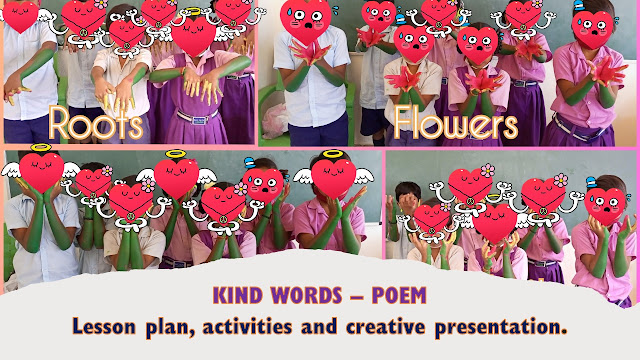
A Creative way of Teaching Poems and Rhymes to the students -("KIND WORDS POEM")- Lesson plan, activities and creative presentation.

Image
Topic: Poem Poem: Kind Words Subject: English Grade: Primary and upper primary Objectives: Able to know the meaning of the words "kind, helpful, nice, and generous" understand the meaning of the phrases "Kind hearts, kind words, kind deeds, and kind thoughts." sing the poem. know the importance of the trees.             Here is a simple lesson plan and activities of the poem Kind words written by Henry Wadsworth Longfellow. And also I am attaching the video of my student's creative presentation . Presentation:   Task 1: Show the below flashcards to the students. Ask some questions pertaining to the pictures. Ex: What do you observe? What are they doing? Have you seen such people? Have you ever helped anyone? ...etc. By asking these questions try to focus to get the words 'kind, helpful, nice, and generous.' Facilitate them to understand the words by explaining their meanings. Focus on the main word "KIND" Task 2: Tell the students to we are goi...