Posts

Showing posts with the label lesson plan

Great Women Personalities - Creative Craft and Classroom Display Activity

Image
Lesson: The Wondrous Women Subject: English Grade: Primary Skills: Creative presentation This activity aims to not only impart knowledge about these great women personalities but also to inspire students and foster a sense of admiration and respect for the contributions of women in various fields. Objective: Students will learn about significant women personalities from India. Students will understand the contributions of these women to various fields. Materials: Printed Star Worksheets. Colour photocopies of Mother Teresa, Kalpana Chawla, Shakuntala Devi, M.S. Subbulakshmi, Yamini Krishnamurthy, Sarojini Naidu, Rani Lakshmi Bai, and Mary Kom. Colour pencils, Colour papers, Sketch pens and Glue. How to do: Distribute the star worksheets to each student. Tell them to colour and crop the star. Distribute pictures of great women's personalities mentioned in the textbook. Tell them to crop the images properly to fix at the centre of the star.  Distribute the colour papers to the studen...

Fun Games to Develop Basic Communication Skills-Teaching Politeness Through Fun Classroom Activities

Image
Developing social skills and polite communication is as important as academic learning for young learners. Teaching students how to make polite requests and express apologies helps them navigate everyday interactions with confidence and respect. Interactive games and engaging activities provide a fun way to practice these essential language skills. In this blog post, we’ll explore four exciting classroom activities— May I , Amazing Race , Find My Pair , and Statue Game —that encourage students to use polite expressions while actively participating in group learning. These activities not only reinforce language structures but also make learning enjoyable and meaningful. Let’s dive in! 1.  MAY I Material Needed: Recordings, picture cards Suggested Words: Things in the classroom ruler pencil eraser book.....etc. Suggested Sentences; May I borrow a pencil? Can you lend me your pencil? Here you are. Thank you. You're welcome. I'm sorry, I don't have one.  How to Play: Students ...

Exploring Basic Shapes in Daily Life- Lesson, Video and Activities.

Image
Lesson Title: Exploring Basic Shapes in Daily Life Grade Level: Pre-primary and Primary Learning Objectives: By the end of the lesson, students will be able to: Identify the basic shapes: rectangle, square, circle, and triangle. Recognize examples of these shapes in daily life. Apply their understanding of shapes to classify objects around them. Lesson Outline: 1. Introduction Show the video to the students. Instructions Before Watching: Ask students to carefully observe the shapes in the video and how they appear in real-life objects. Encourage them to think of examples of these shapes they see in their surroundings. 2. Shape Identification After the video, discuss the following shapes: Circle : Explain that a circle is round and has no corners. Examples: Clock, coin, wheel. Square : Explain that a square has four equal sides. Examples: Chessboard, window, tiles. Rectangle : Explain that a rectangle has two long and two short sides. Examples: Door, book, mobile phone. Triangle : Exp...

Migration of People - Class 5th EVS Lesson Explanation Video and Notes

Image
 Migration of people, class 5th EVS lesson explanation video and notes. The video lesson is useful as a peer-to-peer learning resource in your classroom. In the video students are explained, what migration is? migration types, the effects of migration, and actions being taken to stop migration. Lesson: Migration of people. Class: 5th  Subject: Environmental Science. (EVS) Board: AP SCERT Objective: Students can understand the concept of migration and its effects. 1. What is a migration? A. Migration is a seasonal movement of people from one place to another place in search of a better livelihood .  2. What are the reasons for migration? There are two reasons for people to migrate. They are: Natural reasons : Calamities like floods, cyclones, earthquakes, etc. are the natural reasons for migration. Economical reasons : Reasons like job transfers, and poverty are economic reasons for migration. Migration of People Video: 3. What are the effects of Migration? Mig...

"Mastering Place Value: Innovative Techniques with Digit Flash Cards"

Image
Digit number cards are a versatile and essential tool in a math classroom, particularly for young learners. These cards, typically featuring numbers from 0 to 9, can be used to facilitate a wide range of interactive and engaging activities that help students understand fundamental mathematical concepts. By manipulating these cards, students can visually and physically explore number recognition, sequencing, place value, addition, subtraction, and even more complex operations such as multiplication and division. The hands-on nature of digit number cards supports kinesthetic learning and encourages students to actively participate in their mathematical education, fostering a deeper understanding and retention of concepts through play and experimentation.                  I use digit number cards to teach number concepts, place values, and basic arithmetic operations to my students. These cards are invaluable for creating learner-specific a...

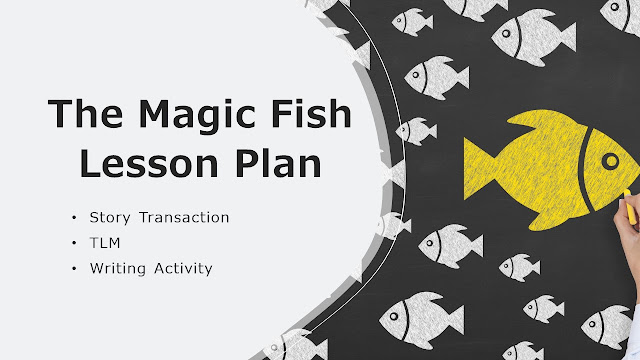
The Magic Fish Lesson Plan - Story Transaction, TLM, Writing Activity

Image
Lesson: The Magic Fish Subject: English Garde: 4th Skills: Reading, Writing, and Speaking                   Here is a creative lesson plan to teach the story of "The Magic Fish" from the class 4th AP SCERT English.  Objectives: Students will be able to identify the main characters, setting, and plot events of the story. Students will demonstrate an understanding of the sequence of events in the story.  Students will summarize the story in a paragraph, demonstrating their ability to convey information concisely.  Students will use the new vocabulary words in sentences to demonstrate comprehension.  Students will engage in a role-play activity, demonstrating an understanding of the characters and events.  Students will participate in class discussions about the story's themes, values, and moral lessons. Teaching Learning Material: Pictures of fisherman, fish, wife, hut, place, house, and flashcards.  Introduction: ...

Save The Planet - Save Our Earth Lesson Plan and Activities to Teach Interactively

Image
Lesson: Our Planet Subject: Environmental Science Grade: Primary and Upper Primary Skills: Values and Citizenship Here I am giving you a simple, creative, and interactive lesson plan to teach the topic "Save our Planet or Save our Earth."  Objectives:  Understand the importance of taking care of our planet. Identify and discuss various environmental issues. Explore practical ways to contribute to saving the Earth. Teaching Aids:  Video clip, ’Save the Earth’, song, ‘Earth Song, song lyrics, Task Sheet  Preparatory: Show students the music video for the ‘Earth Song’ (muted). Students talk about what they see happening to the earth in the video. While listening, students listen to the "Earth Song" and answer the questions on the Task Sheet. Download the Task Sheet. Preparation: Tell the students to read the below paragraph silently Read the test and introduce the new words. (Climate, habitat, protect, forests, earth, greenhouse, emissions, environment) Get the student...

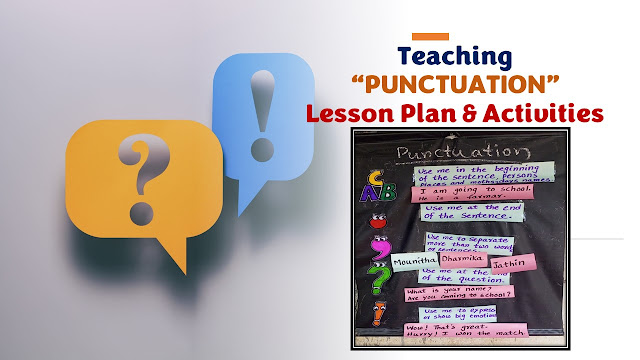
How to teach PUNCTUATIONS for the Primary Students - Lesson Plan and Activities

Image
Lesson Plan: Introduction to Punctuation Marks Grade Level: Primary  Duration: 30 minutes              Here is a simple, creative, and fun-filled lesson plan to teach punctuation topics to the primary students.  Objectives: 1. Introduce primary-level students to basic punctuation marks. 2. Familiarize students with the purpose and usage of different punctuation marks. 3. Teach students to recognize and use punctuation marks correctly in their writing. Materials: 1. Whiteboard or blackboard 2. Markers or chalk 3. Punctuation mark flashcards. 4. Worksheets (optional) Procedure: 1. Warm-up Activity: Begin the lesson by asking students if they know what punctuation marks are. Engage students in a short discussion about why punctuation is important in writing. Give a few examples of sentences with and without punctuation, and ask students to identify the differences in meaning. 2. Introduction to Punctuation Marks Display or distribute flashcards ...

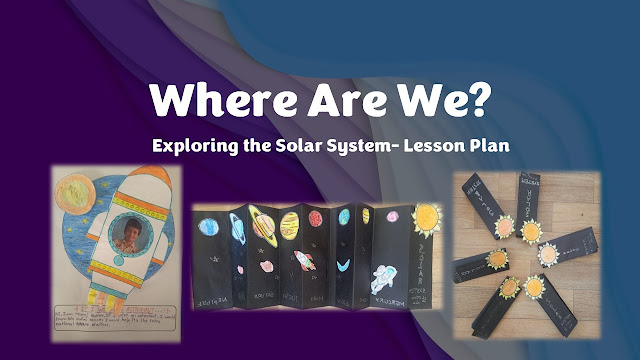
Teaching the Solar System (Where Are We?) - Lesson Plan and Craft Activity

Image
Title: "Where Are We? Exploring the Solar System" Grade Level: 5th-6th grade Subject: Science                The lesson plan "Exploring the Solar System" is designed to introduce students to the wonders of our celestial neighborhood, the Solar System. Through a combination of engaging activities, interactive discussions, and visual aids, students will embark on a journey through space, learning about the planets, moons, and other fascinating objects in the solar system.  Objectives: Students will be able to identify and describe the components of the solar system. Students will understand the relative positions and distances of the planets in the solar system. Students will explore the concept of scale by creating a scaled-down model of the solar system. Students will develop research and presentation skills by creating an informative poster on a specific planet. Materials: Computer with Internet access Poster boards or black large sheet...

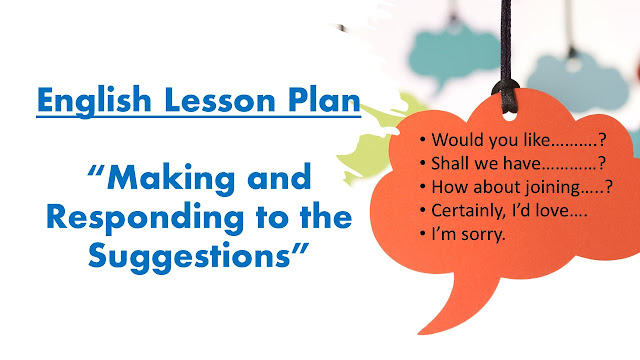
Teaching Model Verbs (Asking and Responding to Suggestions) - Lesson Plan and Activities

Image
Topic: Make Suggestions and Respond to the Suggestions Grade: Upper primary and secondary Skills: Grammar and Speaking Objectives: Define the meaning of "shall we have ...." and "would you like..." in context. Able to participate in daily conversations (a) make suggestions (b) respond to suggestions Identify the situations in which "shall we have ...." and "would you like..." are appropriate. Talk about what each person can and cannot eat and the reasons. Carry out a conversation using appropriate sentence structures with cue cards as guidance. Develop a conversational style that utilizes "shall we have ...." and "would you like..." effectively to initiate suggestions and make requests. Presentation: Get students to talk about the different races in India. Discuss in terms of food, festivals, and beliefs. Read the below paragraph and let them talk.           "India is a country with a rich cultural and religious diversity...

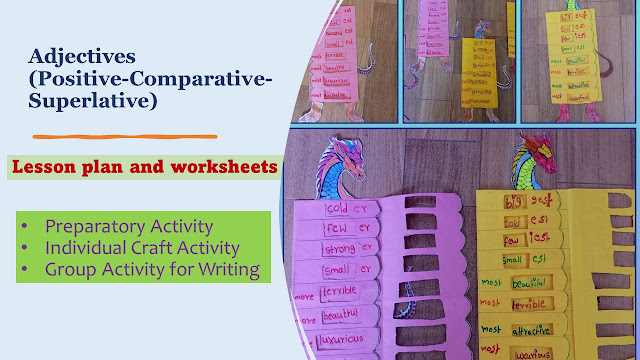
Adjectives- Lesson Plan and Fun Activities

Image
Topic: Adjectives Subject: English Skills: Grammar, writing, and creative thinking Objectives: Students should be able to identify adjectives in the story. write simple sentences containing adjectives. make sentences with comparatives and superlatives. Presentation: Task 1: Distribute the below story card 'The Little Fish and the Big Fat Bean.' Tell students to read the story carefully. Tell them to identify the describing words. Give some examples Download the task sheet.    Get pupils to underline the describing words found in the story. Task 2: After a small interaction, list out the describing words in the story on the board. Explain the contextual meaning and the use of the words in a sentence. Tell them the describing words are called "adjectives." Explain the usage of adjectives. Tell them adjectives have different forms. They are Positive, Comparative, and Superlative Explains the comparative and superlative forms of the adjectives. Examples: (big, bigger, bi...