Posts

Save The Planet - Save Our Earth Lesson Plan and Activities to Teach Interactively

Image
Lesson: Our Planet Subject: Environmental Science Grade: Primary and Upper Primary Skills: Values and Citizenship Here I am giving you a simple, creative, and interactive lesson plan to teach the topic "Save our Planet or Save our Earth."  Objectives:  Understand the importance of taking care of our planet. Identify and discuss various environmental issues. Explore practical ways to contribute to saving the Earth. Teaching Aids:  Video clip, ’Save the Earth’, song, ‘Earth Song, song lyrics, Task Sheet  Preparatory: Show students the music video for the ‘Earth Song’ (muted). Students talk about what they see happening to the earth in the video. While listening, students listen to the "Earth Song" and answer the questions on the Task Sheet. Download the Task Sheet. Preparation: Tell the students to read the below paragraph silently Read the test and introduce the new words. (Climate, habitat, protect, forests, earth, greenhouse, emissions, environment) Get the student...

The Recipe Book - Cooking Up Teamwork - Lesson Plan and Activities to Teach

Image
Lesson: Cooking Up Teamwork (The Recipe Book) Grade Level: Primary School (Suitable for English, Moral Science, or Character Education) Subject: English Language Arts                  What a wonderful story! It's a great example of teamwork and cooperation among different elements in the kitchen. This story could be used as an engaging way to teach primary school students about collaboration and problem-solving. You could turn this story into a creative lesson plan where students get to play different roles like the pot, mixer, knife, and stove, and work together to "prepare" a virtual meal just like in the story. This hands-on activity would not only make the lesson interactive but also teach the important values of helping and working together. Objectives: Understand the concept of teamwork and collaboration. Identify and discuss the roles of different kitchen tools in the story. Promote empathy and helping behavior among students. Material...

Migration and It's Effects Lesson Plan and Activities. Lesson about Migration. Understanding the Migration benefits and effects.

Image
Lesson Plan: Migration of People and Its Effects Grade Level: Primary  Objective: Students will learn about the migration of people, understand the reasons why people migrate, and explore the effects of migration on individuals and communities. Materials: World map or globe Pictures or illustrations of people migrating Whiteboard or chalkboard Markers or chalk Storybooks or videos about migrants (optional) Colour sticky notes. Worksheet: "Migration of People and Its Effects" (prepared in advance) Preparatory: Begin by asking the students if they have ever heard of the word "migration" and what they think it means. Show pictures or illustrations of people migrating and ask the students to identify the different scenes or situations they see. Display the below picture and ask some questions. (1. What is happening there? 2. Have you ever seen such situations? 3. When do such things happen? 4. What do we call the act?) Presentation: Activity 1: Understanding Migration :...

How to teach PUNCTUATIONS for the Primary Students - Lesson Plan and Activities

Image
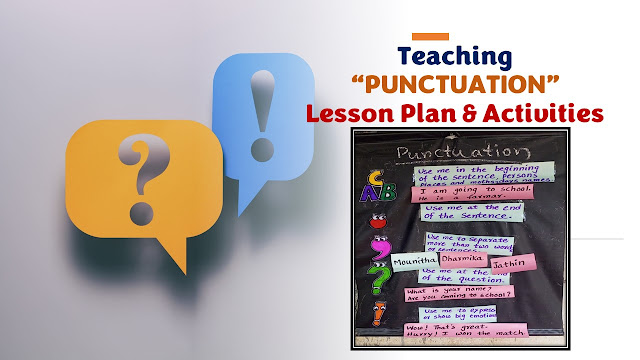
Lesson Plan: Introduction to Punctuation Marks Grade Level: Primary  Duration: 30 minutes              Here is a simple, creative, and fun-filled lesson plan to teach punctuation topics to the primary students.  Objectives: 1. Introduce primary-level students to basic punctuation marks. 2. Familiarize students with the purpose and usage of different punctuation marks. 3. Teach students to recognize and use punctuation marks correctly in their writing. Materials: 1. Whiteboard or blackboard 2. Markers or chalk 3. Punctuation mark flashcards. 4. Worksheets (optional) Procedure: 1. Warm-up Activity: Begin the lesson by asking students if they know what punctuation marks are. Engage students in a short discussion about why punctuation is important in writing. Give a few examples of sentences with and without punctuation, and ask students to identify the differences in meaning. 2. Introduction to Punctuation Marks Display or distribute flashcards ...

Teaching the Solar System (Where Are We?) - Lesson Plan and Craft Activity

Image
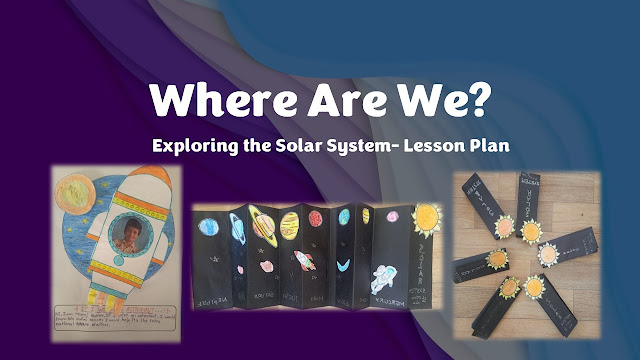
Title: "Where Are We? Exploring the Solar System" Grade Level: 5th-6th grade Subject: Science                The lesson plan "Exploring the Solar System" is designed to introduce students to the wonders of our celestial neighborhood, the Solar System. Through a combination of engaging activities, interactive discussions, and visual aids, students will embark on a journey through space, learning about the planets, moons, and other fascinating objects in the solar system.  Objectives: Students will be able to identify and describe the components of the solar system. Students will understand the relative positions and distances of the planets in the solar system. Students will explore the concept of scale by creating a scaled-down model of the solar system. Students will develop research and presentation skills by creating an informative poster on a specific planet. Materials: Computer with Internet access Poster boards or black large sheet...

Enhancing Language Proficiency: 6 Fun and Effective Vocabulary Activities for ESL Learners.

Image
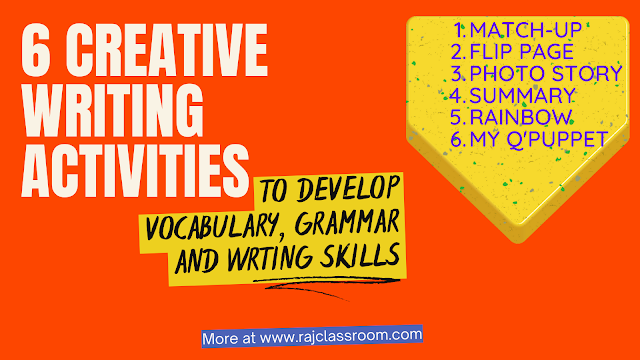
         Simple and creative activities are crucial in developing English writing because they help learners to develop a range of skills that are essential for effective writing. For instance, simple activities such as writing short sentences, paragraphs, or stories can help learners to master the basics of grammar, spelling, and punctuation, which are crucial components of good writing.          Simple and creative activities can also help learners to build their confidence in writing. By starting with simple activities and gradually moving on to more complex tasks, learners can build their skills and knowledge, and gain the confidence they need to tackle more challenging writing projects. This, in turn, can help them to become better writers and communicators, which is essential for success in many aspects of life.            Here are the 6 simple and creative writing activities to improve Vocabulary...

How Puppetry Can Foster Creativity and Imagination in the Classroom.

Image
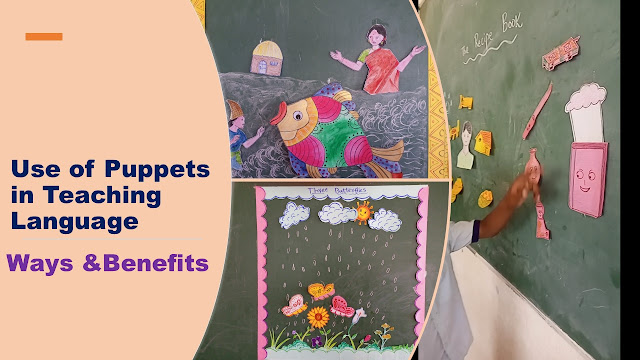
        Stick puppets are a popular tool for storytelling and can play an essential role in developing language skills in children. Storytelling is an essential part of a child's development, as it helps them build language skills, cognitive abilities, and social skills. Using stick puppets during storytelling can further enhance these skills and make the experience more enjoyable for children. Here are the ways and benefits of using puppets in language teaching. 1. Improve Language Skills: The use of stick puppets in storytelling can improve language skills in many ways. For one, children can develop their vocabulary as they learn new words and phrases related to the story. As they listen to the story and interact with the stick puppets, they learn the context of the words and their meanings. This can lead to better comprehension and retention of the language. Watch the videos: I. The Recipe Book - Part 1                 ...